Physics Meets Policy: Why NIST’s New OT Security Guide (SP 800-82 Rev. 4) Changes the Conversation
Regulation
For years, securing critical infrastructure meant speaking two completely different languages.
In the control room, engineers focused on physics, safety, and keeping the lights on. In the boardroom and the SOC, security teams focused on IT policies, patching schedules, and data confidentiality. When an alert fired on an operational network, a massive context gap stood in the way: was it a routine operational command, a failing component, or the first stage of a coordinated cyberattack?
NIST just released the Initial Public Draft of SP 800-82 Rev. 4 (Guide to Operational Technology Security), and it tackles this exact disconnect head-on.
Rather than treating industrial and grid security as an isolated technical silo, Revision 4 rewrites the playbook around operational reality. If you work in critical infrastructure, utilities, or industrial operations - or sit on a board overseeing them - several major shifts stand out in this draft:
🔹 OT Risk is Now Formally Boardroom Risk (CSF 2.0 Alignment): The entire guide has been restructured around NIST CSF 2.0, leading with the Govern function. NIST explicitly states that ultimate accountability for OT cyber risk - and its physical consequences - sits with the CEO, COO, and executive leadership. Plant-floor and substation risks can no longer live on a separate spreadsheet; they must tie directly into the enterprise risk register.
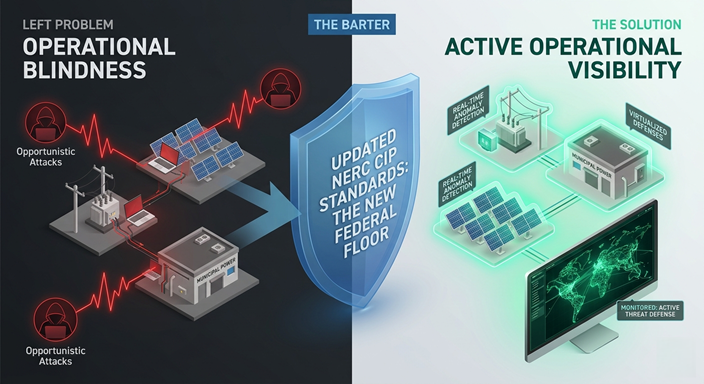
🔹 Bridging the "Context Gap" in Detection: NIST explicitly calls out one of the biggest operational bottlenecks in our industry: security analysts often lack the operational context to evaluate OT protocol traffic, while operations teams are stretched too thin to hunt for cyber threat patterns. Real resilience requires translating raw network behavior and industrial protocols (like IEC 61850, DNP3, and Modbus) into clear operational impact - before a sequence of "routine" commands turns into a physical outage.
🔹 No More "Set and Forget" Compensating Controls: Because OT equipment stays in the field for 10 to 15+ years and can’t simply be rebooted on a Tuesday afternoon, we rely heavily on compensating controls. Rev. 4 makes it clear that compensating controls are temporary bridges, not permanent fixes - requiring formal tracking, clear ownership, and funded transition plans so they don't quietly become risk acceptance by default.
🔹 Separating Control from Management & Accounting for "Cloud Conduits": Modern operational environments aren't air-gapped islands anymore. Between IIoT sensors, remote vendor maintenance, and what NIST calls "cloud conduits" that bypass traditional boundaries, the attack surface has changed. The new architecture guidance emphasizes separating real-time operational control traffic from system management networks, applying practical Zero Trust principles without introducing latency that jeopardizes safety.
🔹 Preparing for What’s Next (AI & Post-Quantum): For the first time, the guide weighs in on using AI/ML and digital twins for anomaly detection, while urging operators to start mapping their cryptographic inventories today to prepare multi-decade field assets for Post-Quantum Cryptography (PQC).
The takeaway from NIST’s latest draft is simple: we cannot solve modern operational security challenges by throwing more manual compliance work or generic IT tools at already overburdened engineering teams. Security in the physical world has to be consequence-driven, automated where it counts, and deeply rooted in how the process actually runs.